What do CIW and Estyn look for in your observations?
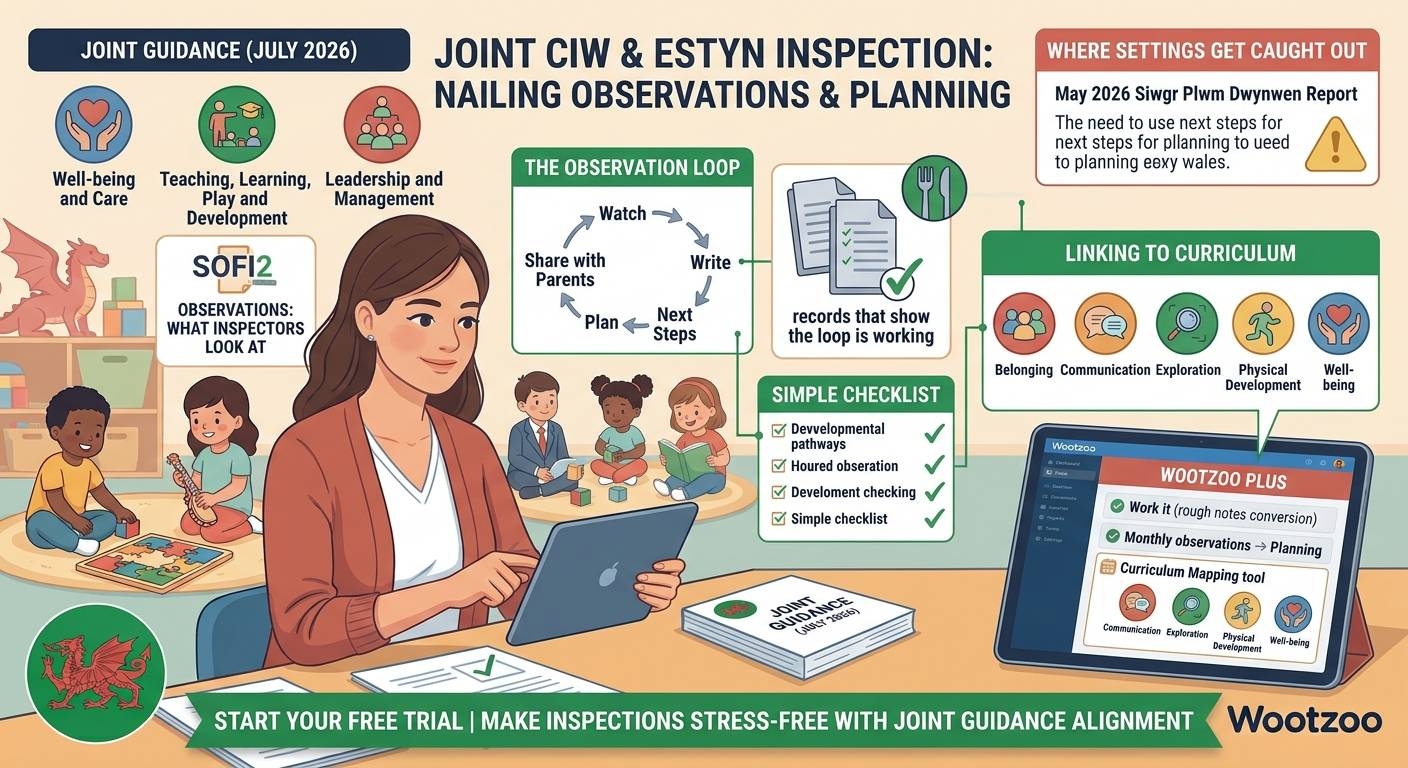
If your setting is funded for nursery education, CIW and Estyn inspect you together. Their joint guidance, updated in July 2026, groups the inspection under three themes:
- Well-being and Care
- Teaching, Learning, Play and Development
- Leadership and Management
Observations sit right across the second theme. Here is what inspectors actually look at, and how to make sure your records show it.
What inspectors do on the day
The inspection usually runs over two half-days. You get 10 working days' notice, and you upload a small set of documents to their Virtual Inspection Room within five working days of being told.
On the day, inspectors:
- watch play and learning, including with the SOFI2 observation tool, and watch how practitioners talk and play with the children;
- talk to people: practitioners, children, leaders, the person in charge, the registered person and parents;
- look at records, including children's individual records and assessment information.
The records that show your observations are working
The joint guidance lists what inspectors look at. The ones linked to observation are:
- information on children's progress and planned activities;
- records of assessments made when children start or leave the setting;
- how parents and carers are kept informed about their children's progress;
- details of support for children with additional or emerging needs.
In short, inspectors want to see the whole loop: you watch a child, you write down what it shows, you decide what comes next, and that feeds into what you plan and what you tell parents.
Where settings get caught out: next steps
One recent example: a Welsh setting inspected in May 2026 was given this as its first recommendation:
"Ensure that practitioners use observations effectively to plan the next steps in the development of children's skills."
The report said practitioners were "beginning to use observations to identify needs and start planning the next steps", but that the information was "not always used systematically enough to inform learning experiences and the next steps for individuals."
So writing observations is not enough on its own. Inspectors look for the next steps, and for those next steps turning up in your planning.
Linking observations to the curriculum
The Curriculum for funded non-maintained nursery settings is built around five developmental pathways:
- Belonging
- Communication
- Exploration
- Physical development
- Well-being
One good observation often shows more than one pathway. A child building a tower and counting the blocks out loud is Exploration and Communication at once. Tagging both makes your records more accurate and saves you writing the same moment twice.
A simple checklist for every observation
- What did the child do and say? Keep it factual.
- Which pathway or pathways does it show?
- What is the next step for this child?
- Has that next step gone into your planning?
- Have the parents seen it?
How Wootzoo helps
Wootzoo was built for Welsh settings, so observations follow the five pathways:
- Several pathways on one observation, with the statements for each.
- What's already been observed for that child shows on every new observation, so you can see gaps at a glance.
- Next steps on every observation, and you can share observations with parents.
- Initial assessments when a child starts, with notes added over time.
- On Wootzoo Plus, next steps from a month's observations go straight into next month's plan. Type rough notes and press Work it for a written-up observation to check.
Sources
- CIW and Estyn, How we inspect funded non-maintained nursery and childcare settings, published 10 July 2026: https://www.careinspectorate.wales/how-we-inspect-funded-non-maintained-nursery-and-childcare-settings-guidance
- Estyn, inspection report, Meithrinfa Siwgr Plwm Dwynwen (inspected May 2026), recommendation R1 and assessment section: https://estyn.gov.wales/app/uploads/2026/07/Inspection-report-Meithrinfa-Siwgr-Plwm-Dwynwen-2026-1.pdf
- Welsh Government, Curriculum for funded non-maintained nursery settings (five developmental pathways): https://hwb.gov.wales/curriculum-for-wales/curriculum-for-funded-non-maintained-nursery-settings/
